
The first stories were fables and there’s a reason they still hold up. Here’s an oldie but a goodie from Aesop’s laptop…
One morning, an old man and his little boy were driving their donkey to market to sell. A group of youngsters laughed at them as they passed by, shouting, “Two fools walking the long road when they can ride a donkey for free!” The old man quietly placed the boy on the donkey and on they went. A bit further on, outside the tavern several old gents angrily piped up, “Typical! A lazy brat takes his ease on a donkey while the old fellow trudges alongside. Get down, whelp, and let your father ride and rest his weary limbs!” Embarrassed, the man and boy quickly swapped places and moved on.
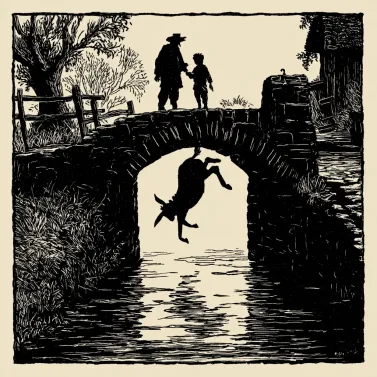
Minutes later, they passed by a gaggle of young mothers, one of whom cried out, “Look at the old monster, riding along like King Farouk while the little boy can barely keep up!” Mortified, the man pulled his son up into the saddle and they rode on together. As they neared the town bridge, a wealthy merchant quipped, “Quite a load for one donkey to shoulder. You two should carry that poor creature instead.” Eager to please, the man and boy climbed down, tied the donkey’s legs together and struggled to carry the beast across the bridge. At the sight of this spectacle, the townsfolk followed after, laughing hysterically. Spooked by the gales of laughter, the poor donkey panicked, kicked free of his bonds… fell in the river and drown. On the long way home, the crestfallen man and boy realized the truth. If you try to please everyone you end up pleasing no one… and you lose your ass to boot.
There is a mythic saying in Hollywood that “Nobody Knows Anything.” William Goldman offered up this treasured bit of wisdom decades ago and the film industry has been fervently ignoring it ever since. Goldman’s point was that everyone you meet in Hollywood will authoritatively explain to you what kind of films will succeed and what kind will flop… and then the much vaunted blockbuster comes out and bombs while the “no chance” indie film turns into the surprise hit of the year. Goldman’s legendary declaration is truer than not, but I’d break it down into two smaller but more specific observations: “A Few Know Something” and “Most Know Nothing.”
A few, like Steven Spielberg and Christopher Nolan, seem to have figured out a few things about storytelling over the years that may not guarantee the success of their films but make those movies a safer bet than not. Most, like virtually every platoon of film executives in every studio, don’t have the foggiest notion what makes a good story. But they do understand business models and thus they have been tasked for decades with trying to discover a consistent business plan for movie making. As in all solid business strategies, the plan is to take the least amount of risk for the most amount of profit, and you need to be able to turn that strategy into a repeatable process. Unfortunately, movies are both an art form and a business. It’s hard to turn art into an algorithm, but Hollywood keeps trying. (*Don’t get me started on AI. That’s for another post.)
The best a writer or director can hope for is that the business people who run the industry will once in a while trust the artists to get it right… and will gamble studio money to let the artists do their thing. Risk assessment has always been the key factor in this evolving equation. As a result, where studio heads once personally gave the greenlight to a movie, that transaction has slowly metastasized over the years into an entire industry that microscopically “vets” film projects in order provide business people with some sense of security in this process. The more people that weigh in on the merits of a screenplay or film project, the more secure the decision makers become that the story is worth gambling on at all. But that leads to the third truism of Hollywood and the scariest one of all: “Everyone Has to Say Something.”
This last truism is the nightmare of every screenwriter in every story meeting they will ever have. Why? Because story meetings are built around this rule. Although only a few know something, and most know nothing, everyone in Hollywood is required to say something when a screenplay is discussed in story meetings. What does this look like in reality?
Picture a film company conference room; or these days, a huge zoom call. A big dog producer or two may be there, the writer or writers have smiles plastered on their nervous faces hoping this won’t be too painful, and a smattering of film executives (or associates, assistants and or interns) will be reassuring everyone that this is going to be fantastic. Then those same executives will be asked their opinion about the script, which, at that point, they may or may not have actually read. Regardless of whether they’ve read it yet, opinions will now flow forth. Some will be polite, some will be fabulously condescending – mainly to remind the writers where they stand in this power dynamic – but all of them will be delivered with authority. The vast majority of these opinions will be wholly irrelevant and often idiotic.
Doesn’t matter. These execs have to justify their jobs and this is part of the job; have something germane to say about the script when the writers show up. But the film executives already know something about this process because they’ve been in it many more times – with many more writers – than the writers themselves will ever be. This ain’t their first rodeo, although it may be the first and last for the writers. And what the film execs know is this: They don’t have to solve the script in this meeting. They don’t even have to understand the script at this point. They just have to say something so that they are seen as having a voice in this process; they are a player at the table. It doesn’t really matter what they say. Just say something because, let’s face it, the damn thing probably isn’t going to get made anyway. It’s more important that their bosses hear them talk with conviction about the script than it is that they actually have any conviction about the script. And, unfortunately, it’s easier to talk with faux conviction about a script’s problems than it is to talk about its actual strengths. Negative comments come across as an objective critique, even if they are pure baloney. Hey, at least you said something.
This is when the nightmare begins. The writer is pressured to agree with all or most of these opinions because he or she is the person who showed up cap in hand hoping these people will make this dream come true. The story meeting will wind up with everyone agreeing that the writer should make the changes everyone else in the room suggested, even if those changes were invented out of thin air ten minutes before the meeting began. What’s a boy to do? The smiling writer slumps back to her laptop and performs surgery on her screenplay to accommodate the often inexplicable recommendations tossed out by everyone at the story meeting. To do this, the writer will often have to cut out or mutilate parts of their plot and characters that they felt were essential to the story itself. Cie la vie! At least the script will now be closer to what everyone seems to be looking for, right?
Yes and no. At the next story meeting, which may be weeks or even months away, a strange phenomenon will occur. Everyone will announce how thrilled they are with these changes… yet no one but the writer will remember why the changes were asked for. In fact, no one will remember what the last draft read like in the first place. No one but the writer, who gutted that last draft to cobble together this new one to satisfy the whims of the people in this room. Everyone will talk about how great the new draft is, but that is more to justify how right they were to suggest changes last time, even though they can’t remember what they actually suggested. It doesn’t matter anyway because that was then, this is now, and it’s only important that they have two new cents to offer about the newest draft. Wash, rinse and repeat!
The only person actually looking out for the integrity of the original script – what made it special in the first place – is the person who wrote it; and perhaps the one or two other people in the room who actually understood its promise when they first read it. Everyone else is here to score points and your script is just the ever changing scoreboard. The wonderful script that you first managed to weave together into a tight, colorful narrative has been transformed into a chaotic patchwork quilt, held together by dissolving thread and cliché formulas, and no one likes it anymore, including you. The film execs summarily show you to the door because “it’s not a good time right now” for this type of project or their dog ate their homework or whatever and you’re back to square one. Welcome to Hollywood!
What is the solution to this nightmare, beyond giving up writing and becoming a rodeo clown? To paraphrase Joni Mitchell, I’ve looked at scripts from both sides now and that has given me an ounce of perspective on this terrible question. Before I ever sat on the writer’s side of the table, with my beloved script in one hand and my heart in my throat, I was seated on the opposite side, with the rest of the star chamber. The portrait painted above was burned into me by watching other writers receive this treatment again and again at the hands of feckless film execs whom I sat beside in these meetings. I was mystified by the power the execs wielded over the writers, simply because each writer was desperate for their script to happen while the execs had a dozen other projects on the go if this one flamed out. But soon I became more bewildered by the story meeting process itself. The execs had all the real power here, but they didn’t seem to know the script very well despite their authoritative tone. Okay, so I realized much of this was theater and ego – say something importantly and it sounds important – but the result was that good scripts were being turned into bland garbage to accommodate the rule of “everyone must say something.” And that was when I discovered a secret, all-important truth…
If everyone must say something, but almost no one remembers what they actually said – because they weren’t really invested in it, even when they said it – then no one remembers what they expected to happen.
When I was on the dark side of the table, I was there as a “script guy.” As such, I carefully read and analyzed the first draft and did the same thing for all subsequent drafts from the same writer or writers. I talked about the script’s true strengths along with what I felt was holding it back in hopes of honestly making the script as strong as it could be. One writer, who was a veteran of longstanding in the business, was understandably enraged by these often demoralizing and pointless story meetings and responded to all of our comments with open contempt. Innately sympathizing with a fellow writer, I objectively knew the script genuinely needed work and wrote up detailed notes in hopes of saving it.
A few weeks later, the writer assured the film execs all of the changes had been made and the script now worked beautifully on every level. Everyone was thrilled. The other execs read the new draft well before I did and sang its praises, saying his changes had solved everything and the script was now better than ever. Then I read it… and discovered the writer had barely changed anything. Thinking I must be nuts, I reread the previous draft and reread my story notes as well, just in case it was me who was out to lunch. Nope. It was clear. The writer had made only the most superficial of changes and hadn’t addressed any of the real issues we pointed out as crucial. Yet everyone was cheering from the bleachers like the script now read like CHINATOWN.
Unsure what to do, I restated the clear issues that remained unchanged and politely suggested the script wouldn’t truly work until they were addressed. The writer’s head exploded and the other execs seemed confused, pointing out that the writer said the new draft addressed all of the issues. That was when I realized the other execs hadn’t actually compared the last draft with the new one because, frankly, they didn’t remember what they’d said back then anyway. They probably hadn’t read the new draft either. The writer claimed he’d made the changes, and since they couldn’t remember what changes they had asked for in the first place, the film execs took his word for it; way easier than having to compare the two drafts by actually reading them.
When another person pointed out nothing had been changed, other execs reluctantly weighed in and the irate writer stormed off to write another draft. When that draft appeared a few weeks later, praised again by the execs as completely changed and firing on all pistons, a quick read proved otherwise. Once more the changes were laughably superficial and every key issue remained, but most of the execs involved felt it was a wholesale and winning rewrite and ran with it. At the time, I was stunned that industry professionals were so clueless or disinterested that they couldn’t see the truth. The writer was lying to them about the rewrites and they were eating it up. At the same time, I thought, ‘good for him’ and didn’t think much more about what this really meant.
A year or so later, I was on the writer’s side of the table, being asked to make irrelevant and idiotic changes to a screenplay I’d sweated over for ages. I was panic-stricken, knowing I’d be forced to make changes which would ruin my script and that those who had demanded them later wouldn’t remember having even suggested them. And then… I remembered the shell game the veteran writer had played on those film execs months before, simply because… this wasn’t his first rodeo either.
The veteran writer knew film execs have to say something, anything, but they certainly wouldn’t check later on to see if any of these frivolous changes had been made. They have better things to do. All he had to do was promise to make the changes, let a number of weeks or months slip by to assure people he was wrestling with a grueling rewrite, shuffle a few sentences and scenes around, and presto, a brilliant rewrite was achieved. If not for script nerds like me, no one would have been the wiser because no one else really cared anyway. I had yet to realize what a precious lesson this writer had gifted me.
Protect the Script. I’d found my mantra. In script meetings, a writer can make his or her case up to a certain point, but after that the suits will have their say. Let them speak their piece. A few of them will offer valid and inspired suggestions that will genuinely improve your screenplay. Most of them will blather on about “inciting incidents” and “building action” while mainly suggesting the protagonist should be younger. Nod gratefully and agree to incorporate these numerous insights into the next, vastly improved draft. Take a few weeks, run with the few inspired suggestions that had merit, shuffle a few sentences and scenes around, maybe change the name of a minor character and presto! A brilliant new draft! Send forth word that the completely revamped script has been borne anew thanks to everyone’s great suggestions… and cross your fingers.
Nineteen times out of twenty, when the execs, agents and whoever else finally read the new draft, they will agree with you wholeheartedly. It’s sooo much better! They will feel validated, your panic attacks will subside, and most of all, you will have protected the script. Is it a bit of a gamble? Probably. Is it worth it? Absolutely. If no one notices, then you’ve salvaged a great script from the mutilation of development hell. If someone happens to notice, you can apologetically admit that you didn’t understand precisely what they were asking for, but now you do and you will totally nail the rewrite. Wash, rinse, repeat! The only thing you’ll ever have to worry about is if some obsessive script nerd is on the other side of that table. But if they are… they’re on your side anyway.